
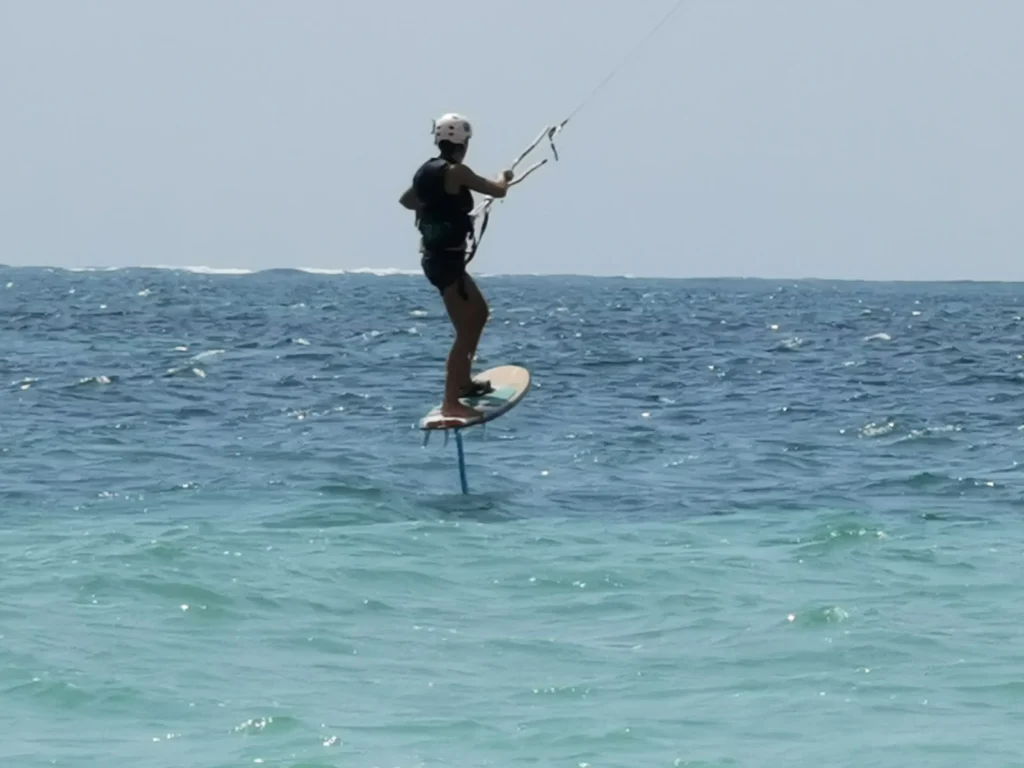
A little guidebook on how [not] to start.
At the outset, I would like to admit that for a long time nothing has rubbed my nose more than learning how to foil. Especially my first steps in this discipline of my beloved kitesurfing. So to the point. I spent the summer season of 2021 at Lake Como in Italy. It is undoubtedly a foiling paradise. Teaching from a boat is different than on land. Often returning from a day on the lake, the wind was not enough for a twin-tip session. The only certain thing was that the wind would slowly die. On my days off, I visited most of the local spots, and often those 2-3 magical knots were “missing”. Do you know who wasn’t missing anything? Everyone who was on a foil. Moreover, they started much earlier and had at least 2 hours of riding more, compared to anyone who used a twin tip. I saw a lot of people on kite surfboards, who were probably convinced that they would compensate for these missing knots. “Been there, done that,” and that’s about it. It just doesn’t work that way. The more I looked, the more I wanted to become one of them – learn how to foil. And next season at Como or any other place on the globe, be able to use every puff of wind! I already knew back then, that I would spend the winter in Kenya – a perfect opportunity to learn that skill.
The decision was made. It’s time for action. First of all, a chat with the boss, a guy of million talents (including a foil champion of 6 knots), and a dealer of one of the brands. He can’t be wrong! “Of course Karo, buy the long mast.” I heard. I consulted my friends one by one, listened to my ego, and decided to buy a set with an 85cm mast. Of course, I knew that it is better to start with a shorter one (at least first 2 sessions) but what the hell, I can’t do it? To make it even more challenging, I figured a crossover surf-foil board would be the best for travel. A surfboard with foil inserts was a revelation. I’ve waited for my new gear patiently for over a month and a half, enjoying my autumn vacation on the Hell peninsula. The set arrived … 3 days after me leaving Jastarnia, but fortunately before the departure to Kenya.
How surprised I was when I packed the quiver and put it on the scale. Over 40 kg! Twin tip, two kites, harness, small accessories .. and a foil set. My eyes popped out a little bit because somehow I knew that aluminum would not paint, but I did not think how much it would weigh. Eventually, the kites were packed in the suitcase, and the clothes were in the quiver. Everything was according to weight limits. The clothes: kites weight ratio was 1: 3, as it should be.
The first assembly took place on Diani Beach. Being aware of how salty water and humidity can hurt the equipment, I screwed everything together using cosmetic vaseline. After 3 months, the disassembly went very smoothly, so I recommend this hack.
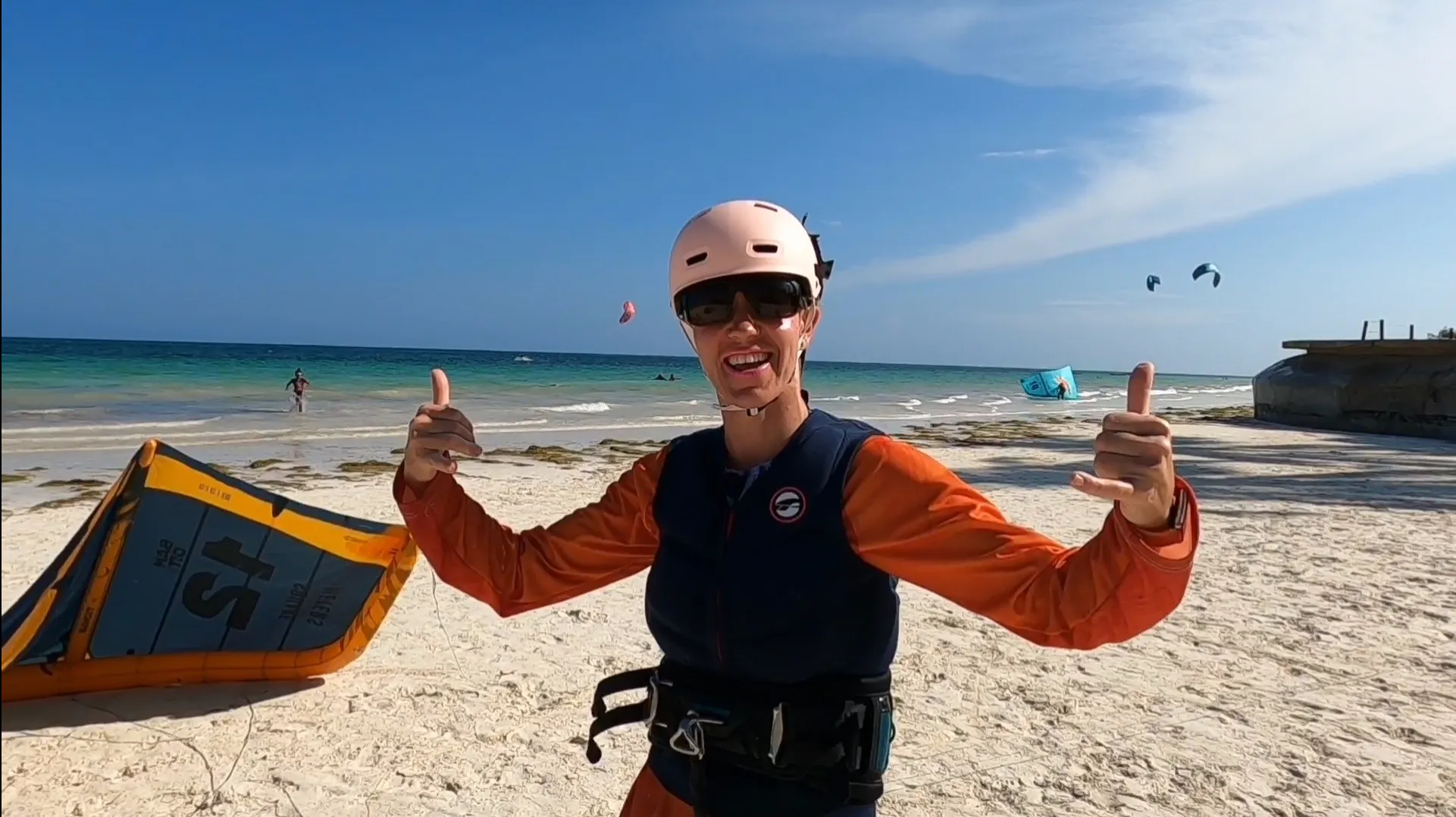
The first session took place at 8-10 knots. I ignored the second most important advice, which is to start in “normal” wind conditions. Foil is great low-wind fun, but it requires quite a lot of skill. You should be able at least to go left and right consistently. “I can fly a kite at zenith in almost no wind” is not enough. I started right after class, at such a pre-season moment, when the wind dropped down a lot in the evening. It grinded me mercilessly. I was doing a waterstart, going for 1-2 seconds in the so-called “Taxi” (i.e. on a board but without levitation). Just after there was only a short levitation, that ended in two ways. Either by shooting into the air or by gaining too much speed and quite a painful fall from those 85 cms. 10 knots can hurt. I thanked fate for the wonderful beach boys. They helped me out with carrying upwind this “crossover of my dreams” foil set .. a set as heavy as a thousand steel anvils. After 40 minutes, three or four such downwinders, I had enough.
I planned the next session poorly because I went between classes, which meant a quick half hour. The decision was dictated by better wind conditions and a desire to improve. I could not forgive myself for such a disaster the first time. I felt overwhelmed, that’s what. I took the advice of my colleague who had been watching me the first time and went there 100% concentrated only to ride in taxi mode. The speed turned out to be unmanageable many times, just like the first time. The plus was that 50% of the spectacular crashes were replaced by wretched stops, sometimes culminating in a little hop into the water. Less spectacular, less painful. Previously, I thought I was theoretically prepared. This time the advice to “press the front leg” I repeated in my head like a mantra. However, it was not quite what I expected. The half an hour did not leave me breathless like the first time. It was a success. Somewhere from that time, Joanna’s comment about my actions stayed with me and I quote: “I have never seen her being so bad in anything before.”
Now is the time to follow another piece of advice to improve the position of the foil on the board. While in dedicated boards, there is often a form of measurement, some hints on the bottom of the board, in my “all in one” there is not. From the “somehow in the middle” setting I went “to the very back” and the third time it popped. My levitations lasted a while now, and my speed was less terrifying. I slowed down. Just when things got uncomfortable, I would quickly say aloud to myself, “Kite up, kite higher, don’t hit it, let it go, let it go”. It helped. Something else definitely helped. Between the second and third attempt, I borrowed a short mast set from a friend. I grabbed it for a bit after class. Here the advice “don’t swim too full” went to the garbage. He was good at 12m, I had a fire from hell (to chyba trzeba inaczej napisać). It wasn’t a total disaster, because this short mast just wasn’t that high above the water and I realized that half of my fails were .. out of fear, with an internal “oooooh shit” by 85cm only.
So the fourth approach was with the optimal 13 knots and the mast position on the board. I moved it furthest back. This session was groundbreaking, I was already doing long levitations and going back to the starting point. Yes, I know, you can ask how you can float downwind on foil. And you can, very easily with crashing and uncontrolled fast levitations (see sessions No. 1 and 2). However, riding downwind (on purpose) in levitation is an important skill and not obvious at all. On the left tack, I did the waterstart (and it still happens to me) with too much angle upwind, and either I went straight onto the wing, or there was a fail and I was just sinking with too much edge applied. I did nice starts on the right. I was proud of myself. No one was running after me on the beach anymore. A new chapter in my head – I can go out and come back. Come back proud that here I am in the same place where I started. It was the moment when I realized how long I hadn’t mastered anything. From scratch. Something new. Demanding a completely new set of skills. More difficult in a way. Here I had to forget a lot to learn anew. Even throughout several sessions, swimming between them on a twin tip meant that the first foil tack felt always a bit “new”.


There is also one session that I need to mention. Well, not all advice is always good! A fellow instructor, who also has a crossover board ( C brand) and has been foiling for some time, after watching my actions, said lazily, “You should try without straps, then it makes much more seeeense”. A year earlier in Rewa, I had tried foil once, then it was a Duotone board (model E with 12m). Pretty nice 40 minutes in late fall. That board didn’t have straps! Moreover, when I mention it, I have the impression that the 40 minutes gave more progress than my first 3 sessions in Kenya. I had a completely different idea about continuing the education that I started at that time. I eagerly unscrewed the strap (I only used the front one) and set off. In about an hour I managed to waterstart twice. Twice. While the swim (as I already took off) was super “free” for my feet, I didn’t feel at all “free” pounding into water time after time trying to climb onto the board. The difference in water between a foil strapless board and a strapless board with foil inserts is huge. It’s not about the displacement, this one differed only by 0.5L! It is about the distribution of the buoyancy, the size, and the shape of this board. For me, holding the surfboard without the help of the front strap (i.e. the front foot) in waves (or the irregular mess of the wave-like pin there) was impossible. The difference between me and Alam was 25kg / 30cm respectively. It was going smoothly for him, I ran out of strength (and probably missed the technique as well).
To be continued..
May the wind be with you!
Enjoyed reading this. It was not what I expected. My quest to foil has taken much much longer. I had previously thought that at a certain point, I would have a “breakthrough” moment, and that it would all come together for me. Not so, I guess. But I keep getting a tiny, tiny bit better, and that keeps me motivated. Patience and determination are the keys for me.
Hi Steve! How was it then for you? I mean, I still crash 😉 and have love hate relationship with foiling, that’s going to be in part 2!