
What I would do differently if I had another shot!
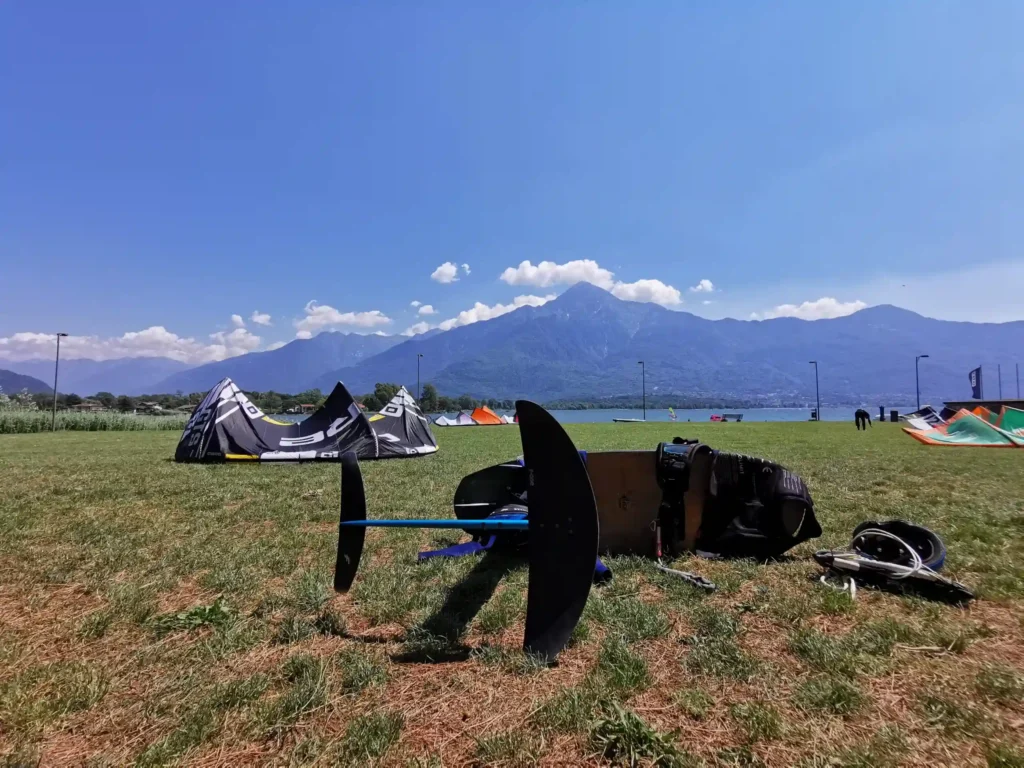
Leaving Africa, I was riding freely in all directions and started my adventure with turns. The continuation of learning took place on Lake Como. My first day off and kiting with foil was at the very beginning of the season. It turned out that a lot was left in the muscle memory. I appreciated the lack of waves and the thermal, incredibly steady wind. From the beginning of my arrival at 414kiting I waited (even waiting) for an opportunity to check out the F-one Pocket. It was a revelation. During one session I gained confidence, speed control was much easier, and the board seemed very stable. In two sessions I started doing jibe transitions and down loop jibe transitions. It was a school board, so it was not always available for me to use. It had 3 straps screwed in standard places. It took me a few sessions to find the right position of the mast on the board relative to these straps for my stance. I only used the front ones and put my foot on the back or just before it. If I put my feet in the back strap as well, I would be almost in the toilet position, way too wide. The issue of stance, or leg spacing, is an individual matter. For my human size (60kg / 170cm), the straps would land in different positions. Hence I could be less forward. I did the theoretical homework on the topic and found a golden mean. Finally, my position was correct, the weight on both legs was even, and the board was not positioned gently up while riding.
My relationship with foil is extremely complicated. I have spent about 20 hours in total foiling. This is nothing compared to the time spent on a twin tip or surfboard. All this time, a kind of war was going on in me. One day I was totally in love with levitation, the next I couldn’t even look at the mast and the wing. There was a moment when a bruised tibia forced the break. I look at the foil scavengers, gracefully flowing around the waters of Lake Como with great envy and admiration. I am at the very beginning of this path and I like it! Endless possibilities for progress.
So, would I do something differently? Yes.
In my opinion, the key to learning foiling is kite control – you have to fly the kite very well in a variety of conditions, especially in light wind. Start in a wind of a minimum of 13-14 knots. Leave the low-wind games until you can ride in all directions. If you doubt your abilities, go strapless at least once before you start. You can go a step further and invest in an e-foil session. It will give you the basic skill and feeling of levitation, so you will be able to focus more on the kite. Make sure that the equipment you start on is suited to you and is a beginner set. I’m not saying you should buy one! If you want to learn on your own, you can borrow the equipment from a friend or a kitesurfing school. Prepare yourself theoretically and mentally. Many things you will have to unlearn and forget. Remember in kite foiling, you are learning to control the wing (which is underwater). The board is an extremely important link between your body and the wing. Do not underestimate the basics like foil handling or body dragging. One front strap on the board, in a very loose position, is quite enough. It’s supposed to be so loose that it only allows you to hold the board just before the start. A foil crash can happen from various positions and at high speed, believe me, you don’t want to have your foot attached to the board anywise (from experience!). From a safety point of view, I consider a helmet and a vest mandatory. Be aware of the presence of the mast and the wing underwater – it’s nice to remember about it and not to kick it. Be prepared for a crash, the reflex “kite at 12 and pull the bar” will guarantee a fall away from the board. As it should be.

In this discipline, listen to advice. I thought that I was listening and I knew better, and I did not know and was the most surprised in the world. In a way, it’s learning from scratch. Based on kitesurfing skills, but very different. This season, I watched a lot of beginners. Everybody struggles more or less. On average progress on a foil can easily look like this: the first session, mastering the board handling, riding in “taxi”, maybe first short levitations, second session: longer levitations, riding both left and right. Only because it seemed to me that I knew better, I wasted time. My progression might have been easier. It is worth waiting for better conditions. It is worth paying attention to personalizing the equipment, beginner equipment. It is worth approaching foil with humility. Learning from mistakes, including those that are not yours, will speed up your progress!
Of course, the easiest way is to take those 2-3 first hours as a lesson. If you don’t want that, just ask a friend to record you or give you some notes. It really helps to have an outside point of view.
See you on the water! May the wind be with you!