
The trip.
We arrived in the last week of November. Several airlines fly from Europe. Direct flights are available from Paris and Madrid (Fall 2022). For us, starting the journey in Sicily, meant a departure from Palermo with two stopovers, in Rome and Madrid. We chose Air Europa because they were the only ones who had the option to transfer the luggage straight to the final destination. Luggage checked in Palermo for collection in Lima. That was it. When flying with two board bags, we take into account not only the costs but also the options with the least amount of carrying this junk.
In Lima, a taxi to Paracas was waiting for us. The route can be easily done by bus. The bus ride is cheaper (around 10€). Again with two board bags and two suitcases, the cost of transferring luggage from the airport to the bus stop, with 2 people, plus the bus comes close to the price of a taxi. I need to mention the changeover in Madrid. The departure from 23:55 was postponed by over an hour, the plane was exchanged for a working one, and 30 people did not get on the new one. Due to this confusion, Dantesque scenes took place. Classic pressing, screaming, and crying ensued. We succeeded to board the plane. Luckily.
The town.
Paracas is a small town, the size of Polish Jastarnia, and the rank of a resort. It is located in the desert. All vegetation is tended by people. It is maintained by people. It just doesn’t rain here. Apparently, in 2017 it rained and paralyzed the place, with no electricity, flooded streets, etc. In Paracas life happens outside. Patios, terraces, streets. Contacts and cables outside. Outdoor kitchens and launderettes. Lots of dogs on the streets. Calm, not looking for provocations. Especially stray ones.
I have a simple message for those who don’t know what to expect. There is civilization here. Everything will be ok. No need to worry about the lack of a toilet (I got such a question, seriously). Peruvians are clean – by Italian standards. There is garbage on the streets, depending on the place. There is 30% more sugar in everything than in Europe. You can see it looking at people. From Paracas, for any major shopping, you should go to Pisco or even Ica. Taxi to Pisco costs 5s or take the “collectivo” bus it is 3s. Mototaxi to the spot from the town is 3-5s. However, you don’t have to bargain here every step of the way, this is not Kenya. You can, you don’t have to. Prices for groceries, provided that we eat what locals eat, are lower than in Europe. Imported products are appropriately expensive. The currency that is useful here is USD. Euro and £ are not used, and they are harder to exchange. To polish PLN 1s ~ 1PLN, to EUR/USD 4s ~ 1€. We cook, eat street food or go to local restaurants. You can easily eat under the cork for about 25s. You can fit even less per person per day. This is great. The locals use salt – a lot, sugar – even more, and spices – don’t get me started. There are sauces, sauces, sauces for everything. The more European you want to eat, the fancier the seafood, and the more expensive it gets. Overall good quality food and living conditions.
Kite spot at Kangaroo Kite!
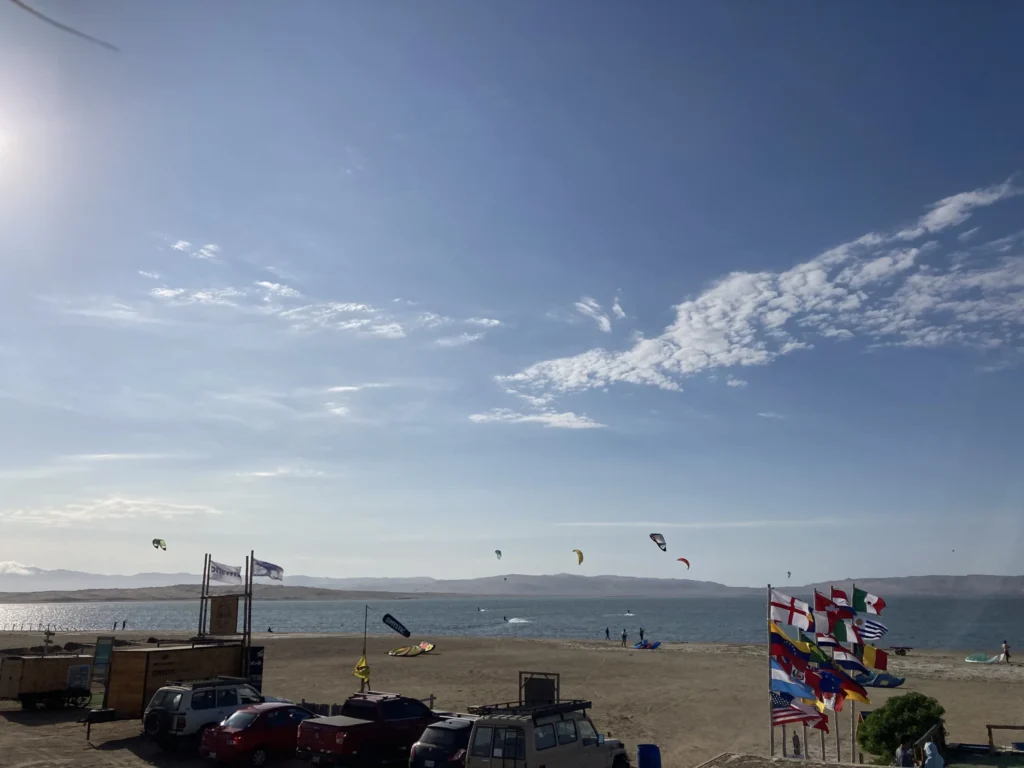
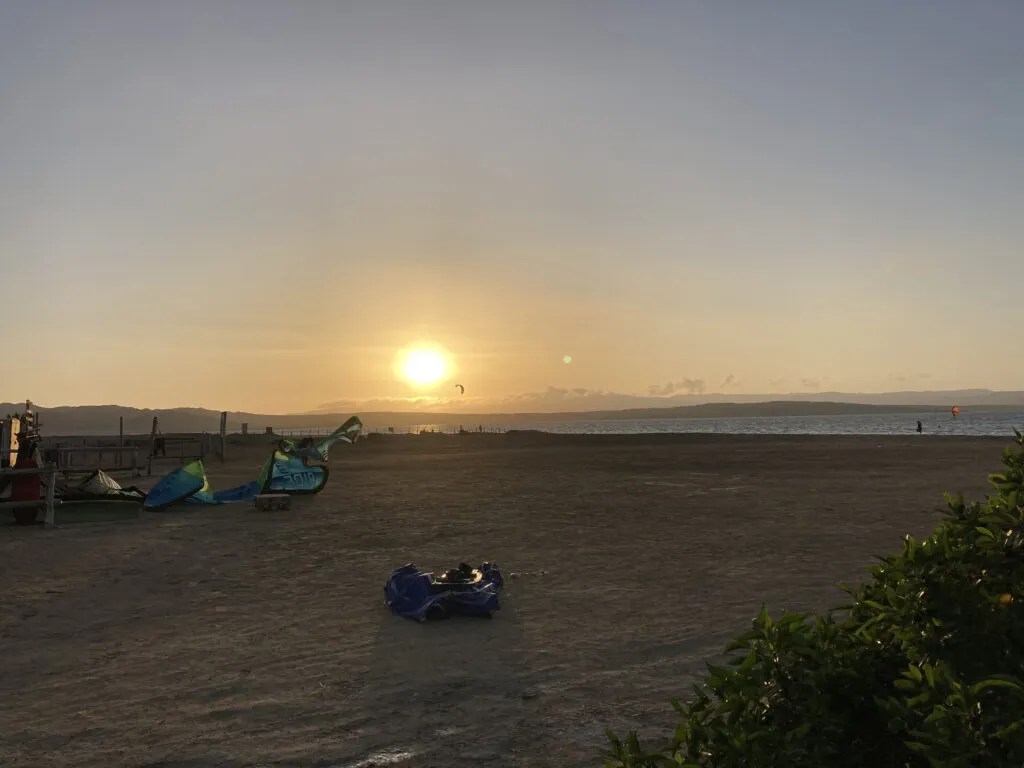
The spot in Paracas is, as I wrote, a 5-minute moto taxi trip away from the village. There are villas and hotels along the entire shore of the bay. Where the hotels end you will find a piece of beach with a spot right on the border of the reserve. The wind is side off-shore. Its strength (and direction) changes throughout the day. In the morning it can be N and then you wait for it to turn to S and strengthen. Usually, this happens in a blink of an eye. Usually (a statistic after only 5 weeks) it dissipates around noon, the wind strength increases to 20-25 knt, and has a maximum of about 3 pm. It is gusty, there are “kicks” shooting you up. Later in the afternoon the wind weakens a bit and stabilizes. It’s freestyle time then. If I would kite all day, it would be 11m kite (approx. 1-2h) -> change to 8m and then return to 11m (or not!). These sizes are with my weight of 60 kg. There are no dangers in the water. There is nothing to stand on, but it can be muddy. There are jellyfish. There may be a lot of them. By a lot, I mean when that when you look down after a jump, you see a checkerboard of white and red jellyfish below you, every 2m each. That’s what I’ve seen the most. Then they will grow. Locals say that they reach large sizes (diameter over 1 m). When it comes to the depth of the water, it is a bit like the offshore side in Rewa with a western wind. I wouldn’t call it a flat. There is one place where it is almost flat, near the “end of the spot” where the wind gets lower and gustier, through the wind obstacles. Further out to the bay it’s just choppy. I could even call that “kickers for the left leg”.


First impression.
We are here for kitesurfing. For me, it’s a bit like a “work and travel” solution. I’m freelancing at mentioned earlier Kangaroo Kite. So far I’m not complaining. In mid-December there was some kind of a political coup, which unfortunately results in a drastic drop in tourists. The situation is stable now, but will the traffic get back to normal? I hope this suspension doesn’t last too long. On the other hand, it’s nice to have so much time to kite and wing foil.
It’s windy. It’s safe. It’s cheap. The town is quiet. It’s a typical slow-life place. After spending exactly a month here we are pretty happy with the place.