
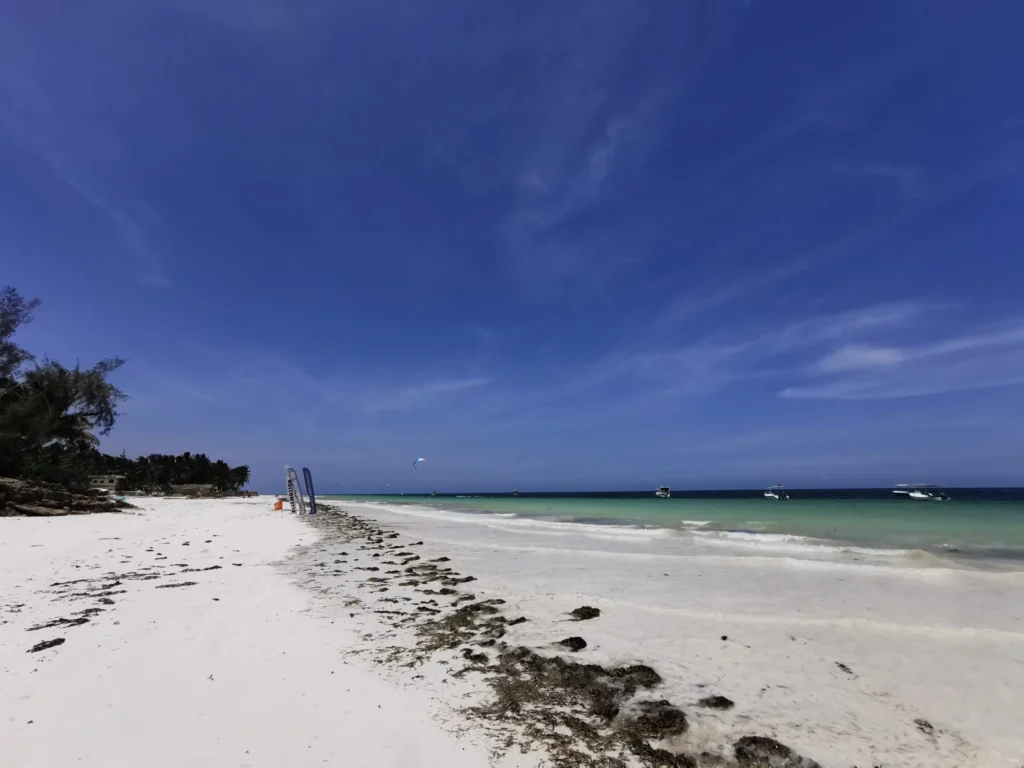
Diani Beach, located on the southeast coast of Africa, is situated to the northwest of Madagascar. This part of the Kenyan coastline lies almost in a southwest direction.
Getting Here
To reach Diani, it takes approximately an hour from Mombasa. However, you must catch a ferry from Mombasa, so the actual travel time may vary. You can reach Kenya by flying directly to Mombasa, even with charter flights available every weekend. Alternatively, you can fly to Nairobi and then take a domestic flight to Mombasa. This option is quite convenient and budget-friendly, especially if you book last-minute flights.
At the Spot
Diani Beach is surrounded by a reef. At Kitemotion’s Kite School level, the reef is approximately 1.5 kilometers from the beach, creating tide-dependent conditions similar to a lake. You’ll find a wide sandy beach, beautiful palm trees, relaxed resorts, and a variety of flora and fauna.
This location is particularly beginner-friendly, with no shore break, no strong currents, plenty of space on the beach, and both shallow and deep water conditions. The wind is steady. Wave riders will find excellent conditions at the reef break, while freestyle enthusiasts can enjoy butter-flat water at the sandbank and flat/choppy conditions at the main spot.
Alternative Activities
If the wind is not blowing, there are plenty of other activities to enjoy, such as going on a safari, snorkeling, diving, hitting the gym, or simply relaxing. Kitemotion, based at SoulBreeze Resort, offers a sporty atmosphere with activities like volleyball, tennis, and monkey gym. “Pole pole” (slowly, in Swahili) is not just an empty phrase here.
I must say that this place is very accessible.
Details
- Location: Kenya, south of Mombasa, Indian Ocean
- Safety: Very safe, with on-spot rescue services. In deeper parts, be cautious of seaweed with sea urchins; avoid going out during the lowest tide.
- Wind: Steady
- Dec – March: Kaskazi, 12-17 knots, N, NE
- Jun – Sept: Kuzi, 16-30 knots, S, SE
During the winter, it’s more of a spot for larger kites (my basic kite was an 11m GTS5 from Core) and an excellent foil spot. When I was there I was not yet a wing foil enthusiast, and now knowing I’m going there again, I just can’t wait to get myself pumped on the wing again!
One day average
Statistically, the wind usually starts around 10-12 in the morning, more suitable for foiling. Around 14, you can switch to a twin tip or a smaller kite. The wind persists until nightfall, with its strength tied to the tides; it comes in with the water. Sunny days typically bring stronger winds than indicated by Windguru, while clouds may signal lighter winds. Tides here can reach up to a 3-meter amplitude maximum, occurring during full moon and other lunar phases.
Kitemotion.pl
I also spent three months teaching at Kitemotion.pl. They have excellent infrastructure for lessons, rentals, storage, and rescue services, all conveniently located at the spot. Accommodation is either right at the spot or just a 5-minute walk or tuk-tuk/moto ride away, depending on your preference. The beach is beautiful and wide, providing ample space to set up your gear, even on busy days. During the peak season, you’ll quickly find a spot just for yourself to ride. If you’re a wave-riding enthusiast, consider bringing a buddy with you, as the reef is quite far from the shore, and it’s safer to have company up there, just in case.
I hope you enjoyed the video and hit that like button. Don’t forget to subscribe to my YouTube channel to stay updated.
P.S.
This material was recorded in the beginning of 2022. After a 2-year break, I have decided to go there once more. There is something in this place that draws me back. It is so alive, so green, so tasty, and has all I need to progress my riding and teach kitesurfing in good conditions.
If you want more details about everyday life this post Asante sana for the pole pole lesson Kenya! will deliver.
Maybe we will meet there?
But wherever and whenever we may meet, may the wind be with you!